



Most British gardens were not designed with fire in mind. They were designed around a lawn mower, a shed, a rotary line and a view of next door's fence. That does not rule out a fire pit, but it does mean the planning matters more than the pit itself. Get the siting, the base and the clearance right, and even a four-by-six-metre plot will take a fire bowl comfortably. Get them wrong and you end up with a scorched fence panel, a smoky washing line and a neighbour who has your number.
Start With the Space, Not the Fire Pit
Before you buy anything, walk the garden at the time of day you would actually use it. That is usually early evening, which is also when the wind drops and smoke starts to hang rather than clear. Stand where you would sit, look around, and note what is close: fence panels, a shed, a conservatory, a bin store, low branches, a summerhouse, next door's upstairs windows.
As a working rule, keep at least three metres between the fire and anything that will burn or melt, and more if the wind tends to push towards it. Manufacturers often specify their own clearances — follow those if they are greater. You also want the air above the fire clear for a couple of metres, which rules out lighting up under a pergola, an awning, a parasol or a tree with low branches. Sparks rise, and so does heat.
Wind and smoke direction
Smoke is the thing that turns a pleasant evening into a complaint. Prevailing winds in the UK generally come from the south-west, but every garden has its own quirks thanks to walls, hedges and neighbouring buildings. A quick test on a still evening: light a candle or a stick of incense where the pit would go and watch where the smoke drifts. If it heads straight at your back door or over the fence into next door's patio, shift the pit or accept that you will only use it when the wind is friendly.
Leave a clear gap between seating and the fire itself — at least a metre of paving, so nobody has to lean over hot metal to get to their chair. A fire pit you cannot walk around is a fire pit you will stop using.
The Base and the Ground Around It
Fire needs something non-combustible, level and stable underneath it. On that score, small gardens offer more hazards than you might think.
- Good: properly bedded paving slabs, clay pavers, brick, compacted gravel, sand, or stone chippings over a firm sub-base.
- Poor: decking, artificial grass, bark mulch, woodchip, dry lawn, rubber mats and loose dry leaves.
Decking deserves a special mention, because it is where a lot of small-garden fire pits end up. Boards scorch, and heat travels downwards as well as up. A fireproof mat and a raised stand reduce the risk but do not remove it, and many people sensibly decide not to light a fire on timber at all.
If you want a permanent spot, lay a paved circle roughly 1.5 to 2 metres across with the pit centred on it. It defines a safe zone, protects the grass, gives you somewhere to put a bucket and a pair of gloves, and looks deliberate rather than improvised. A sunken pit — turf or slabs lifted, gravel lining, fire bowl set in — works well but does collect rainwater, so make sure water can drain away rather than sitting in the hole.
Choosing a Pit That Suits a Small Plot
In a tight garden, height is your friend. A raised bowl on legs or a chiminea with a chimney draws smoke upwards and away from faces and fences, which matters when your neighbour's washing is two metres away. Flat ground-level bowls smoke lower and are harder to keep clear of children and pets.
Whatever you choose, look for a spark guard or mesh lid — in a small garden it doubles as a windbreak and stops embers landing on dry grass. Weight and stability matter too: cast iron or heavy steel with a wide footprint is less likely to tip than a light pressed-steel bowl on spindly legs. And resist the urge to build a great brick monolith. In a small garden, that kind of structure eats the space you were trying to enjoy.
Fuel and Technique: Where Most Smoke Comes From
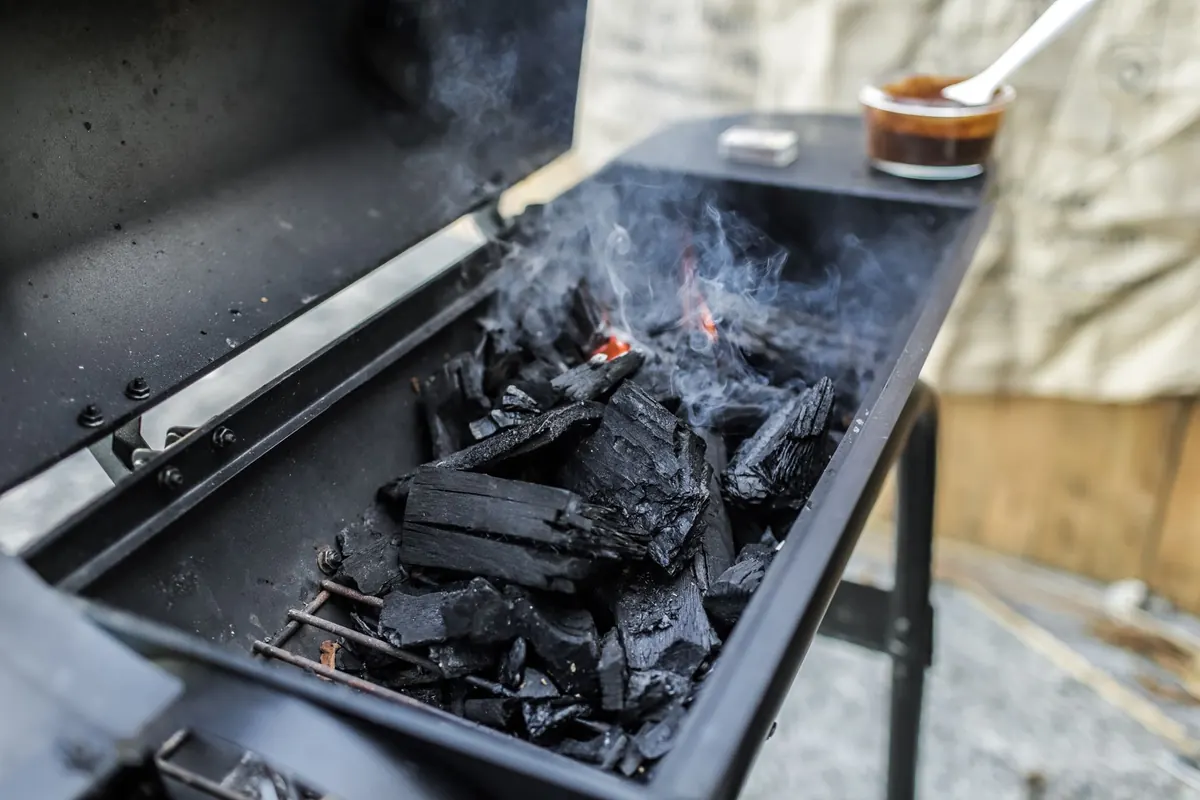
Smoke is largely a sign of incomplete burning. Damp wood, too many logs at once, or a fire starved of air will smoulder and produce far more smoke than a small, hot fire.
Use dry, seasoned hardwood — kiln-dried logs are reliable, and ash, oak and beech burn well. Avoid softwoods and conifers if you can, as they spit and leave resin, and never burn treated timber, painted offcuts, MDF, chipboard or household rubbish. Petrol and other accelerants have no place near a garden fire; proper firelighters and dry kindling do the job.
Build small. A handful of kindling, a firelighter, then logs added one or two at a time as the fire establishes. Once it is hot, much of the smoke burns off in the flame itself. Do not smother it with a lid or a pile of logs, and where possible let it burn down naturally rather than dousing it halfway through, which produces a thick cloud of steam and smoke.
Smoke, Neighbours and Local Rules
Persistent smoke from a garden can be treated as a nuisance, and local councils can act on complaints — so it is worth knowing where you stand before a neighbour raises it. Rules vary, so check with your local council if you are unsure, and check your tenancy agreement, leasehold terms or any estate management rules if you do not own the freehold outright.
Practical goodwill goes a long way. Keep burns short, avoid damp evenings, do not burn garden waste in a fire pit, and give next door a heads-up if you are planning a long evening. If smoke is drifting into a bedroom window, you have your answer about where the pit should sit.
A Simple Safety Routine
- Check the wind and the forecast before you light anything.
- Clear the zone: sweep leaves, move cushions, mats, toys, washing, anything plastic.
- Have water or sand within arm's reach, plus a long lighter and heat-resistant gloves.
- Light small and build up slowly. No accelerants, ever.
- Never leave a lit fire unattended, and keep children and pets behind a barrier or a paved edge.
- To finish, douse with water, stir the ash, then douse again.
- Put cold ash in a metal container, not a plastic wheelie bin — ash can stay hot for a long time.
Empty a fire bowl or cover it when you are done. A bowl left full of rainwater will rust, and a wet pit is a miserable thing to start the next time.
Getting It Right First Time
A safe fire pit area in a small garden is not a big project. It is a paved circle, a stable pit with a spark guard, a sensible gap to anything that burns, and a routine you follow every time. Test it first on a still evening with a small fire before you invite anyone round, and move the pit if the smoke tells you it is in the wrong place. Do that, and you will use it far more often than you would expect.
If you are unsure about local rules, leasehold restrictions or anything involving shared or rented space, check with your council or the relevant property professional before committing.
Photo: mibro / Pixabay
Related posts
More stories you’ll love reading